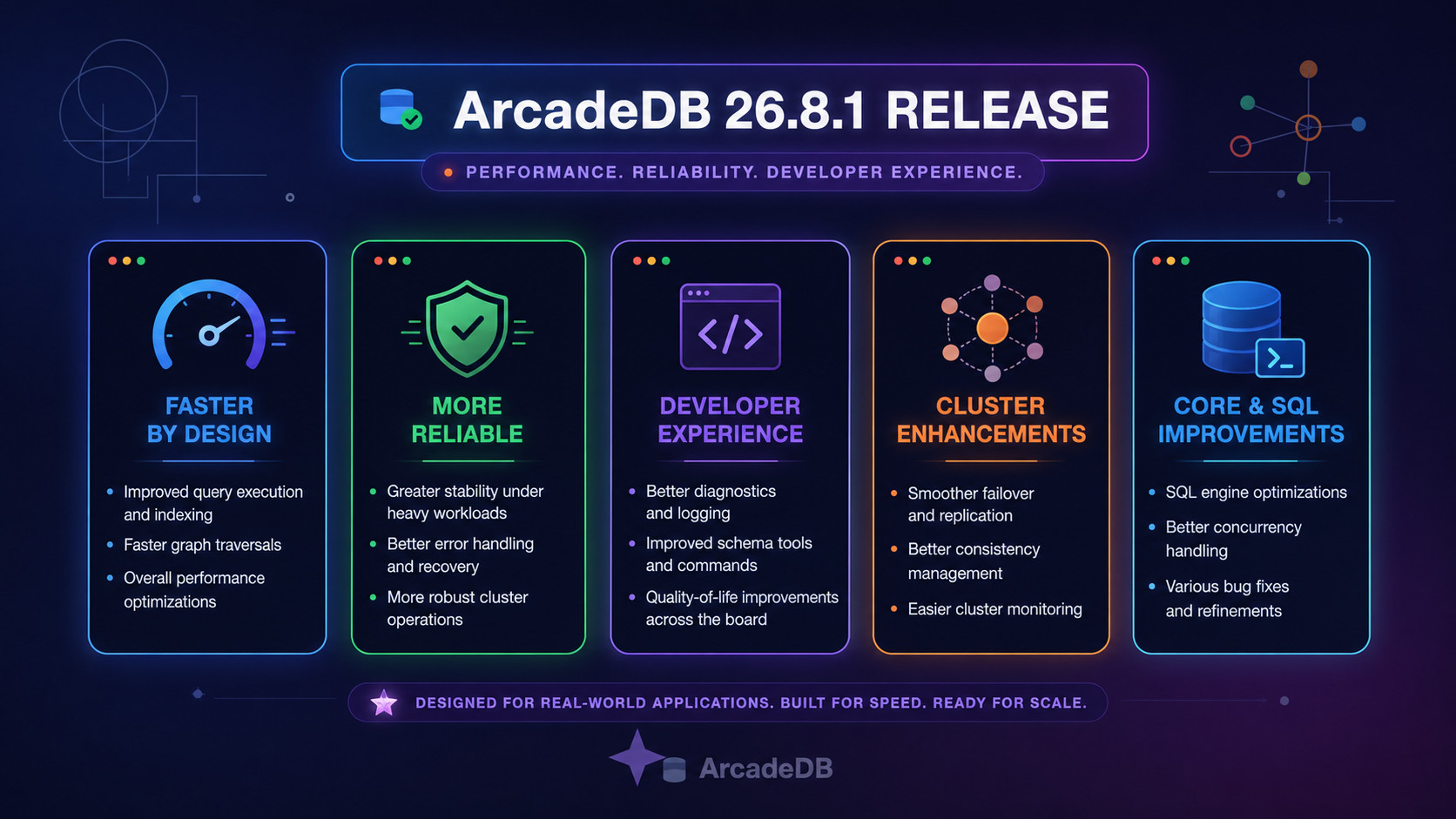
ArcadeDB 26.8.1 is a major release: 381 issues and pull requests closed under the 26.8.1 milestone, 281 issues and 100 PRs, out of 298 pull requests merged and 669 commits since 26.7.2. It also carries everything shipped in the 26.7.3 hotfix.
The headline work is in four places:
- Concurrency: concurrent writes to unrelated records of the same page no longer conflict, which is what made ArcadeDB usable under real multi-writer load on types with few buckets.
- Graph integrity: a family of vertex and edge delete defects that could silently lose edges under concurrency is closed, and deleting a super-node vertex got 5x faster along the way.
- Storage and indexes: bloom filters on compacted LSM series, a schema dictionary that is no longer capped at one page, a geospatial index that costs one entry per point instead of eleven, and TimeSeries TAG columns that are dictionary-encoded.
- Security: 13 advisories closed, most of them on the wire protocols and the MCP endpoint.
Upgrading is strongly recommended for every deployment. There are breaking changes and behaviour changes; no schema migration is required, and no existing database is rewritten.
Major Highlights
Concurrent Writes to Unrelated Records of the Same Page No Longer Conflict
ArcadeDB detects write conflicts per page, so two transactions that touched the same bucket page raised a ConcurrentModificationException even when they wrote completely unrelated records that merely happened to share it. On a type with few buckets and many concurrent writers this made a retry pointless: the retry ran straight into the same collision (#5279).
All three halves of that are gone:
- Inserts into one page reserve their slot per in-flight transaction, so concurrent inserts get different positions (and different RIDs) instead of all being handed the same one.
- Updates are replayed by the commit-time disjoint-slot merge whenever they stayed inside the page, which now includes a record that grew (a longer string, one more property) and not only an overwrite of the same size or smaller. Growth is the normal update shape, so leaving it out kept concurrent updates conflicting.
- Deletes of a plain in-place record are replayed too (#5569). Such a delete only zeroes one slot-table entry, so it commutes with writes to every other slot.
Measured on the reported workload (one single bucket, attempts=1, no retry):
| Scenario | Before | After |
|---|---|---|
| Concurrent inserts | ~1750 conflicts / 2000 | 0 |
| Concurrent sub-graph creation (6 vertices + 5 edges per transaction) | ~270 / 320 | 0 |
| 10 transactions updating 10 different records of one page | 9 failed / 10 | 0 |
| Sustained updates, 8 writers on their own records of one page | ~2083 / 2880 | 0 |
| 8 deletes + 8 updates of 16 different records of one page | 15 failed / 16 | 0 |
| 10 transactions deleting 10 different records of one page | 9 failed / 10 | 0 |
A ConcurrentModificationException is still raised, by design, when two transactions really write the same record: a byte-for-byte pre-image check makes sure no concurrent write is ever silently overwritten. Nothing changes for single-writer workloads and no application change is needed. The merge can be switched off with arcadedb.txPageSlotMerge=false.
The merges also prove their coverage now instead of trusting every writer to declare its pages (#5596): a page carrying even one byte written outside a declared, replayable write is refused and falls back to the ordinary retry. The three merge counters (edgeAppendMerges, txPageSlotMerges, mergesDeclinedByCoverage) are now visible to an operator in the PAGE-MANAGER block, in /api/v1/server, in Studio and on /prometheus (#5608).
Deleting a Vertex No Longer Loses Its Edges, and Is Up to 5x Faster
Four defects, all on the same path, all capable of committing a graph with edges pointing at a vertex that is gone (#5670, #5680, #5725, #5760):
- An edge-list chunk that is momentarily unreadable, a normal MVCC window on a hot vertex rather than a fact about the graph, was read as “nothing to remove here”. The removal ended having removed nothing and the edge record was deleted anyway, leaving a back-reference on a neighbour. It is now a retryable
ConcurrentModificationException, so the transaction re-reads a consistent view and completes the removal. - The same window on the vertex’s own list meant no edges collected, and the vertex record deleted on top of that empty view.
- An edge appended while the delete was running survived the delete with a live
outand aninnaming a record that no longer exists. A vertex delete now pins every page its edge list can grow through, at the version it read the list at. - Each edge was disconnected from both endpoints, one of which is always the vertex being deleted, whose lists are dropped wholesale moments later. Each edge is now disconnected from its far end only.
That last one is also where the performance is. 100k edges into one hub, on an Apple M-series laptop:
| Layout | Before | After |
|---|---|---|
| Promoted super-node (striped) | 2374 ms | 446 ms |
| Classic single chain | 350 ms | 308 ms |
The removal walk streams now: deleteVertex no longer materialises every edge into a list first, so there is no per-degree allocation on the path at all (tens of megabytes of retained heap on a million-edge super-node).
Visible effect.
vertex.delete()/DELETE VERTEXandedge.delete()/DELETE EDGEcan now raise a retryableConcurrentModificationExceptionwhere they previously “succeeded” while losing an edge. It is aNeedRetryException, sodatabase.transaction(...)and the server’s auto-retry for single-request commands absorb it. A client-managed explicit transaction overRemoteDatabasespans several HTTP requests, so its commit is not auto-retried and the caller should retry the transaction. A delete that keeps failing however often it is retried means the list is genuinely broken: the error now names the repair,CHECK DATABASE RECORD #12:3 FIX, and the retry after it goes through.
Bloom Filters on Compacted LSM Indexes (Enabled by Default)
An LSM index lookup walks every compacted series from newest to oldest, and a series whose key range covers the key still costs a root-page search and a data-page read to discover it does not hold it. Each compacted series now carries a bloom filter that answers from a single 8 KB page (#5517).
Measured on 2M keys across 9 series (LSMTreeBloomFilterBenchmark):
| Measurement | Filters off | Filters on | Gain |
|---|---|---|---|
| Absent-key lookups (a duplicate check) | 199,743/s | 386,138/s | 1.9x |
| Pages read for those lookups | 1,490 | 705 | 2.1x fewer |
| Bytes read for those lookups | 372 MB | 176 MB | 2.1x fewer |
| Present-key lookups | 244,000/s | 281,150/s | 1.2x |
- On by default at a 1% target false-positive rate:
arcadedb.indexBloomFilterRate=0.01. Set0to disable. - ~1.2 bytes per key on disk, about 3% of the index it describes, in a
<index>_bf.bfidxcomponent. - No rebuild and no migration. Filters are written by compaction, so an existing index gains them at its next compaction. They replicate over HA and are included in backups.
- Helps most when compacted series overlap in key range: an email, a UUID, a business id. Ascending keys give each series a disjoint slice the root page already rules out. Range scans never consult them.
- Observability:
bloomSkippedSeriesandbloomProbedSeriesin the index statistics.
Backward and forward compatible with no version bump: an older ArcadeDB does not recognise the .bfidx extension and reads the index exactly as it does today.
The Schema Dictionary Is No Longer Capped at a Single Page
Every type and property name is mapped to a small integer id, and that table lived in one page: 48,396 short names measured. Past it, CREATE PROPERTY and inserting a document with a new field name failed permanently with No space left in dictionary file, with no way to grow and no way back (#5560).
Names now roll over onto further pages, so the cap is gone.
- No migration, and existing databases are not rewritten. A dictionary written by an earlier version is a dictionary of one page and loads unchanged; it gains rollover on the next write that needs it.
- Appending a name is no longer quadratic. Growing to 500,000 names took 11.2s of pure array copying; it now takes 2ms.
- New databases use a 65,536-byte dictionary page instead of 327,680, so a new name dirties and flushes 5x less. Existing databases keep the page size they were created with.
Rolling upgrade: upgrade followers before, or together with, the leader. Dictionary pages replicate as raw pages, and a follower on an older build writes page 1+ but reloads only page 0. A database that has rolled over can no longer be opened by an older ArcadeDB at all, loudly rather than silently.
Geospatial Index: a Point Costs One Entry Instead of Eleven
A GEOSPATIAL index stored the whole GeoHash ancestor chain, so a single point wrote one entry per tree level, 11 by default. Everything an index write costs was multiplied by 11, and the continent-sized cells at the top of the tree collected one posting per record and grew without bound, which is why a bulk load with a geospatial index got slower the longer it ran and finally failed with ReplicatedEntryTooLargeException (#5478).
On an LSM-Tree, “every cell below C” is simply a key range, so the ancestors do not need to be materialised. The index now stores only the frontier cells, exactly one for a point, and answers a query with a prefix range scan. On a 1M-point load into one country-sized box (GeoIndexIngestBenchmark):
| Arm | Wall clock | Index entries |
|---|---|---|
| No index (the floor) | 10.8 s | n/a |
| New layout | 13.0 s | 1,000,000 |
| Old layout | 22.4 s | 11,000,000 |
The index costs 5.3x less, the whole load is 1.7x faster, and the index is 11x smaller on disk. Area shapes index fewer cells still: a complete set of sibling cells collapses into its parent, 57% fewer for a small square and 74% for a jagged outline. Queries are also more selective and stream their candidates instead of materialising the whole set, and a POINT search shape now uses the index at all (geo.equals / geo.contains used to find nothing and fall back to a full scan).
Existing indexes keep working and are not rewritten: the layout is recorded per index. Opening the database says so once per index, and Studio shows a banner with the ready-to-run statement:
REBUILD INDEX `Address[location]`. Note theshapeRelhalf of the fix lives in the shared query walk, so an index still on the old layout also stops skipping covering cells the moment the jar is swapped.
TimeSeries TAG Columns Are Dictionary-Encoded: 36x Less Page Traffic
A TimeSeries mutable row is fixed-stride, so a STRING TAG column reserved 258 bytes whether the tag was us-east-1 or empty. Tags are low-cardinality by definition, so nearly all of that was padding that still had to be written, flushed and shipped through the WAL (#5519).
A TAG column now holds a 4-byte id into a per-type append-only dictionary component:
| Arm | Stride | Rows per 64K page |
|---|---|---|
| 1 tag, 3 fields | 290 B to 36 B | 225 to 1819 |
| 10 tags, 3 fields | 2612 B to 72 B | 25 to 909 |
| 10 tags, 10 fields | 2668 B to 128 B | 24 to 511 |
The ten-tag arm went from writing 50.0 MB of pages for 2.1 MB of payload (23x amplification) to 1.4 MB (0.7x), and from 29.9 ms to 6.0 ms. Corroborated independently on real TSBS data (2,592,000 points) by @tae898 in the issue.
arcadedb.timeSeriesTagDictionaryMaxSizecaps distinct values per type, default 1M.- STRING fields stay inline: a field is where high-cardinality text belongs.
- Existing types keep the inline layout. The row format is versioned per type; a new TimeSeries type gets the encoding, an existing one has to be recreated to gain it. If you are benchmarking, point the harness at a fresh database or you will measure the old layout.
MCP: a Module of Its Own, New Tools, and Per-Principal Scoping
The MCP server is now a dedicated arcadedb-mcp module (#5692) and gained the tool surface that makes it usable as a GraphRAG back-end:
vector_search(dense and sparse),hybrid_search,full_text_searchand a boundedsample_records(#4860, #4861, #4862, #4863).- Prompts
graphrag_queryandbuild_knowledge_graph, the latter with an enforceable source-text fence (#4866, #5586). - Configurable tool profiles, per-database permission scoping and per-principal profiles on a shared endpoint (#4867, #4868, #5445).
- MCP 2025-03-26 transport conformance: batches, notifications, GET and Origin handling (#5394), plus proper JSON-RPC
-32602for malformed members instead of HTTP 500 (#5585, #5620).
Much of this arrived from @justinblethrow-cloud.
Experimental: GraalVM Native-Image Build of the Server
An experimental native-image build of the ArcadeDB server is now part of the build (#5544): a single self-contained binary with no JVM start-up cost. Experimental means exactly that, it is not yet part of the published distribution.
Security Advisories
This release closes 13 security advisories, on top of the three closed in 26.7.3. Each is published in full (impact, affected versions and credit) as a GitHub Security Advisory on the repository; the summaries below are only a map of what changed. Upgrading is strongly recommended for any deployment that exposes a wire protocol, the MCP endpoint, or accepts queries from untrusted callers.
Authentication and authorization on the wire protocols
- GHSA-fq9c-x968-g278: the MongoDB protocol accepted commands without authenticating the caller. It now authenticates and enforces per-database authorization.
- GHSA-m46c-jh3x-xwrp: the Redis protocol required no authentication. It now requires
AUTH, supports theHELLOhandshake, and can be served over TLS. - GHSA-c287-v325-j5jx: the Gremlin protocol did not enforce per-database and per-type authorization.
The authenticated principal is now bound on every execution path
The engine’s per-user permission gates are deliberately no-ops when no principal is bound on the thread, which is how embedded and replication contexts skip them. Three paths reached the engine without binding it, so every gate silently passed:
- GHSA-p29f-345w-4qwf: the gRPC transaction thread.
- GHSA-5j4x-3jfw-8xv3: the async command worker thread.
- GHSA-c23x-pqcj-7hfm: the batch and time-series HTTP handlers, so per-type ACLs did not enforce.
Privileged operations that were not gated
- GHSA-pff6-hp53-pj54: the server-administration MCP tools (
set_server_settingand the profiler controls) gated only on the globalallowAdminflag and ignored the caller. They are root-only now, matchingPOST /api/v1/server. - GHSA-vv82-qvpf-rjwv:
DELETE FUNCTIONdid not requireUPDATE_SCHEMA. - GHSA-hfp5-6gcp-8c75: Cypher
LOAD CSVcould read local files without administrative privilege. - GHSA-qwgr-2c45-63xx: the database name was not validated when creating or dropping a database, allowing path traversal outside the configured database directory.
Untrusted input reaching the host
- GHSA-4w2m-77c8-83mw: a caller-supplied URL was validated only on its first hop and re-resolved after the check, so a redirect or a DNS rebind could reach an address the validation had rejected (SSRF). Every hop is validated now, and the validated address is pinned for the duration of the fetch.
- GHSA-wx28-2265-f788: the scripting host-class allow-list was matched as a regular expression, so an entry could admit far more classes than it names. It is matched literally now.
- GHSA-xmjm-8q85-g778:
range()materialised every element, so one query could exhaust the heap. The list is lazy now and a range beyondarcadedb.queryMaxRangeSizeis refused as a client error.
Also hardened in this release
- MongoDB protocol: field names and filter values can no longer inject SQL. A MongoDB command is translated into SQL, and the field names and values taken off the wire were embedded without escaping. A filter value containing a single quote closed the string literal, so an
updateManywith a craftednameupdated every document; a$unset/$incfield name containing a back-tick removed a property the client never asked for. Values are now bound as parameters and every field name is back-tick quoted, one dot-separated segment at a time (#5579, #5583). - Server and cluster status endpoints scope their per-database output to the caller.
GET /api/v1/cluster, theha.databasesarray ofGET /api/v1/server?mode=clusterand themetrics.sparseVectorIndexesmap now reduce every per-database entry to the databases the caller is authorized for.POST /api/v1/cluster/bootstrap-stateandGET /api/v1/cluster?presence=truemove behind the root check the seven mutating Raft endpoints already use. - Studio no longer carries schema names in inline
onclickhandlers (#5580).
New Features
Storage and Indexes
CHECK DATABASE RECORD <rid>: check and repair named records only, instead of two full passes over a type (#5680). Combines withFIXandCOMPRESS.CHECK DATABASE FIXreclaims orphaned edge-list segments (#5375), and rebuilds unreadable edge lists from the surviving edge records.- Live progress for
CHECK DATABASE,REBUILD INDEX,COMPACT INDEX,BACKUP DATABASEandIMPORT DATABASE, in the engine, over HTTP, in the console and in Studio (#5372, #5376). COMPACT INDEXis reachable from SQL/HTTP, not only from the Java API (#5144).GEOSPATIALindexes have a builder of their own, soprecisionandtokenizationare settable from SQL:CREATE INDEX ON Location (coords) GEOSPATIAL METADATA {"precision": 6}.- An
LSM_VECTORindex compacts itself once its file is mostly garbage (#5516). -
HASHindexes can key on aLINK, so an edge type’s@out/@inpair can be indexedUNIQUE_HASH, the structural way to enforce edge de-duplication, which used to be accepted and then fail on every insert claiming page corruption (#5677):CREATE INDEX ON INITIATED (`@out`, `@in`) UNIQUE_HASH
Server and Operations
- Opt-in SLF4J logging.
Slf4jLoggerroutes ArcadeDB’s logs through the SLF4J facade instead of writing to stdout, keepingjava.util.loggingas the default, so an embedding host application gets consistent logs (#4276).arcadedb.log.implis now a properGlobalConfigurationentry (#5543). Contributed by @ruispereira. - The OpenAPI spec matches the registered HTTP route surface (#4895).
arcadedb.server.httpQueryDefaultLimitmakes the HTTP row cap configurable (default 20000,-1for unlimited), and truncated responses say so.
Query Engines
- Parallel top-K for
LSM_SPARSE_VECTOR: a sparse top-K is split into parallel RID ranges (#4085), 3.4x on real SPLADE data. - Cypher
CREATE CONSTRAINT ... IS UNIQUE/IS NODE KEYupgrade a plain index in place, so a Neo4j migration script that creates indexes and then constraints keeps working.
Major Fixes and Improvements
Bulk Load
- A failed bulk load answers immediately instead of waiting for the rest of the upload.
POST /api/v1/batchrejects a payload it cannot use, but did so only after reading the rest of the upload, so on a 25M-line load the client was told nothing for fifteen minutes and then nothing at all (UT000002: The response has already been started). The verdict is now delivered as soon as it is reached (#5470). GraphBatch.close()restores the configured WAL flush, not the default, so durability is no longer silently downgraded after any bulk load (#5378).- Two concurrent
GraphBatchinstances on the same database are refused instead of silently losing edges (#5666). - Time-series HTTP ingest batches into one append transaction per measurement.
Graph Engine
- Deleting an edge no longer leaves its back-reference behind under concurrency, on all three operations that disconnect one:
DELETE EDGE, moving an edge, andDELETE VERTEX(see the highlight above). - Ghost-edge pruning during iteration no longer rolls back and replaces the caller’s transaction (#5694).
TX_RETRY_DELAYis read from the database configuration instead of the global static, so a per-database override applies (#5693).- Broken multi-page records are deletable again by every path, and
CHECK DATABASE FIXrepairs them.
Indexes
countEntries()no longer counts tombstones as live entries. Deleting every record of a type left the index reporting1with zero records in the database (#5601).- An index cursor never hands out a
nullentry,hasNext()is exact,next()throwsNoSuchElementExceptiononce exhausted, andgetRecord()/getKeys()describe the entrynext()last returned (#5635). Two user-visible consequences fixed with it:SELECT min(...)/max(...)could answer with a deleted key, and a delete-heavy index reported one entry too many. CursorisAutoCloseable, and a leaked cursor no longer pins a retired index file for the lifetime of the database (#5662).- A
HASHindex refuses a page size its bucket pages cannot address. Above 65536 bytes the 16-bit slot offsets truncate and the index destroys itself on insert, reported asDetected cycle in hash index(#5713). - Partitioned types, three fixes. A lookup on a secondary index was pruned to the bucket the lookup key hashed to rather than the partition key’s, so a secondary
UNIQUEindex stopped rejecting duplicates (#5589). A lookup key boxed differently than the stored value hashed differently, so on aLONGpartition key every negative value missed (#5595). And a partition key whose bucket is not a function of the index key (BINARY,DECIMAL, zone-carryingDATETIME,COLLATE CI) is now refused instead of quietly breakingUNIQUE(#5603). The strategy is also persisted now (#5637). CREATE INDEX IF NOT EXISTSanswers for the index asked for. It matched on the property set alone, so aNOTUNIQUEindex answered “already there” to a request for aUNIQUEone and the constraint was never created (#5675, #5765).- An existing index is never dropped implicitly any more. Opt in with
withReplaceIfIncompatible(true). - Manual indexes work.
ManualIndexBuilder.create()registered the wrong object, so the very next commit fenced the database (#5765). - Copying a type copies its records and its index definitions, not just their names (#5723).
REBUILD INDEXno longer resets a non-default GeoHashprecision, and an indexMETADATAkey is now either applied or reported (#5639); four dense-vector settings that were unreachable behind that silence (efSearch,inactivityRebuildTimeoutMs,neighborOverflowFactor,alphaDiversityRelaxation) are now settable and persisted.- Full-text BM25 is comparable across buckets (#5267), and a combined full-text index expands per property (#5181).
- Bounded range scans over multi-series compacted indexes no longer drop rows or mis-order descending results (#5214), an accented partial prefix no longer returns rows of other keys (#5321), and a mixed-type index range is bounded by type category (#5225).
- A
STRINGproperty no longer reads back as a geometry. Deserializing any string whose first characters werePOINT,POLYGONand so on parsed it as WKT and handed back aShape(#5600).
Vector Search
- A search aimed at a deleted region finds the survivors instead of nothing. Two independent causes: the traversal was told every node was an acceptable answer, so a beam that filled with tombstones declared itself finished; and a tombstone was scored through a placeholder vector whose cosine similarity came back
Infinity, making every tombstone the best candidate in the beam (#5558). countEntries()is no longer torn by a concurrent graph rebuild (#5568).- The location cache is gone and
locationCacheSizeis refused. It was never a cache bound: an evicted location is unrecoverable and every reader reads a missing location as deleted, so a cap of 100 over 1000 live vectors madecountEntries()report 100 and dropped neighbours from searches (#5559). - In-memory bloat is fixed:
VectorLocationobjects were never removed from the map, an OOM after weeks of operation (#5516), andLSMVectorIndex.remove()no longer scans every vector id per call (#5318). - A committed vector is no longer intermittently missing from search (#5615), and
GraphSearcherPoolcan no longer hand out a searcher bound to a replaced graph (#5648). - Sparse vectors: compaction no longer fails past the 2GB WAL buffer (#5189), the top-K heap no longer allocates a
Floaton every comparison (#5473), and block-max skipping cuts the p50 that tracked total posting length (#5388). - Studio can create a vector index (#5607), and
dimensionsis now enforced at creation: an index created without it accepted writes and indexed nothing, forever, without a warning.
TimeSeries
DATE/DATETIME_*/DECIMAL/BINARYfields no longer silently corrupt the next column, and the sealed layer restores the declared column type (#5475).- Unbounded last-point-per-tag no longer scans the whole series (208 ms to 2.5 ms) via a per-shard latest-ts shortcut (#5414), and an unbounded descending scan no longer reads the whole unsealed tail (#5416).
- Ingest no longer boxes every numeric sample (#5474).
HA / Raft Clustering
- A materialized view no longer makes the leader ship page versions followers never received (#5492), the
WALVersionGapException/ non-converging-resync / lost-write shape. Both SQL and Cypher statements now execute against the replicated database instance rather than the innerLocalDatabase(#5655). - A follower’s index can no longer be short after an LSM compaction, which silently returned fewer rows (#5443).
- Concurrent transactions on a shared follower
Databasehandle no longer corrupt records or lose committed writes (#5503). - A leader crash between the Raft commit and the phase-2 apply no longer loses a locally-originated write (#5407), and the phase-2 ticket is released when an abandoned entry applies (#5410).
- The Raft log no longer grows unbounded until disk-full on low-write clusters (#5345), and a permanently wedged follower replication channel now escalates instead of staying dead until a leader restart (#5346).
- The leader is no longer advertised as available before it is ready to serve (#5453), and
DROP DATABASEno longer deletes files synchronously inside the Raft apply (#5454). - Kubernetes: a recreated follower is no longer permanently stranded (#5268), a peer is no longer silently removed from the Raft configuration when its pod is deleted (#5275), a stranded follower’s Raft server is no longer left
CLOSED(#5271), the crash-loop onnewTI < oldTIis gone (#5291), and the defaultraftStorageDirectorylands insideserver.databaseDirectory(#5272, #5277). - Cluster status is accurate: the configuration is re-emitted rather than logged once at bootstrap (#5304), the
LATENCYcolumn reports replication RTT rather than heartbeat age (#5314), a never-appended follower is no longer reportedHEALTHY(#5295), andPOST /api/v1/cluster/leadervalidates its body (#5276). - Polymorphic
count(*) FROM Vno longer returns node-dependent totals from bucket counter drift (#5297), and parameterized Gremlin commands work on followers (#5187). - A failed startup no longer leaves an unkillable JVM (#5450), non-daemon background threads no longer keep an embedder JVM alive after a leaked
Database(#5418), andschema.load()no longer runs beforecheckForRecovery()(#5325).
OpenCypher
- A hop onto an already-bound vertex counts every relationship joining the pair. The optimizer’s operator for such a hop was built as a semi-join, so it answered once per input row and threw the rest of the pair away. The shape where it shows is a cycle, whose closing hop always has both endpoints bound: anything aggregating over such a pattern under-reported wherever parallel edges exist between a pair, which is normal in transaction and payment graphs (#5663). Row counts can go up, and that is the fix.
- An unbound
$parameteris an error, not null. A query referencing a$namethe caller never bound evaluated it to null and ran to completion against a value nobody supplied, so a de-duplicatingWHERE NOT EXISTS { ... } CREATEguard degraded into an unconditionalCREATE. ArcadeDB now raises Neo4j’s ownExpected parameter(s): id(#5501, #5561). - A subquery body is part of the query, not a string it carries.
EXISTS { },COUNT { }andCOLLECT { }held their body as text, edited it once per outer row to correlate it, ran it as a standalone statement and absorbed any failure into the expression’s neutral value (false,0,[]) (#5656, #5657, #5658). Bodies are ASTs now, run with the outer row as a seed, and a failing body is reported (#5626). - A non-numeric argument to
abs()and friends is a 400, not a 500 (#5484, #5602), with the message phrased in the vocabulary of the language:Type mismatch: abs() expects an INTEGER or a FLOAT argument but got STRING. - Arithmetic errors are client errors. 64-bit overflow, division and modulo by zero answer HTTP
400and Bolt’sNeo.ClientError.Statement.ArithmeticError(#5545, #5647). Floating-point is untouched. - The two count push-downs agree.
RETURN count(*) LIMIT 0returned a row; a pattern that cannot match cost 200 record reads to answer 0;MATCH (a)-[:LINKS]->(b) RETURN count(*)with an unlabelled anchor answered 0 (#5715, #5686). - Inline
WHEREpredicates apply everywhere they are written: inMATCH, inEXISTS { }, in pattern comprehensions, on variable-length patterns and in bothshortestPathevaluators (#5460, #5462, #5463, #5464, #5480, #5481, #5489, #5490). - Planner: an inline property map is planned as the equality predicate it stands for (#5446); a bound-target expansion filters on the segment’s neighbour pointer (#5660); composite indexes are seeked by their whole key (#5444); and bounded variable-length paths use indexed and IN-list anchors (#5357, #5387, #5393).
SQL
- Integer arithmetic fails on overflow instead of wrapping, and division by zero is a client error (#5164, #5647, #5494).
- Back-tick quoted names containing a backslash are no longer mis-parsed. A name that arrived already escaped grew one backslash on every parse and re-emission until it no longer resolved.
MATCHESworks when the regular expression contains multiple dots (#5258), theMATCHrid filter is no longer discarded (#5315), andTRAVERSE/SELECTfrom a bound RID collection no longer NPEs (#5505).UPDATE ... MERGEsupports parameterized payloads (#5347).- A large batch script no longer dies with
StackOverflowErrorwhen closing its execution plan (#5708, #5720). ceil()/floor()return FLOAT (#5382),||rejects non-STRING operands (#5298), chained comparisons are honoured (#5284),split()with an empty delimiter no longer appends a spurious element (#5390), anddatetime(map)honoursepochSeconds/epochMillis(#5274).dateTimeImplementation=java.time.Instantno longer breaks reading DATETIME values. The moment a DATETIME column crossed the JSON boundary it threwUnsupportedTemporalTypeException: Unsupported field: YearOfEra, which took out HTTP, the remote driver, Studio,toJSON()and the SQL.format()method.
Server, HTTP and Observability
- A truncated query response is no longer indistinguishable from a complete one. The HTTP endpoints serialize at most 20,000 rows and reported that nowhere: same
200, same body shape (#5711). Alimitthe caller states is now honored as written, a query’s ownLIMITraises the cap, and the response carries{"limit": 20000, "returned": 20000, "truncated": true}.RemoteDatabase.setMaxResultRows(Integer)sets it per connection; Studio marks the row count(truncated). - Query and HTTP metrics survive an in-process server restart (#5565).
- Unexpected internal server errors stay visible in production-mode logs (#5374), with the full stack trace.
- HTTP status classification: client errors are classified on the Postgres, Redis, MongoDB and GraphQL wire paths (#5628), the command API no longer answers
500 ClassCastExceptionfor a non-stringlanguageorcommandfield (#5222), and JSON array payloads are accepted (#5415). - The “not found” message for a missing bucket reaches the user again (#5636).
Schemanow exposes null-returninggetBucketByIdIfExists(int)/getBucketByNameIfExists(String). - The remote driver honors the server’s 503 “please retry”, and the console no longer terminates a comment on a semicolon (#5457).
Wire Protocols
- PostgreSQL: quoted identifiers are identifiers, not string literals (#5369); the schema path no longer collapses
ARRAY_OF_*/DATETIME_*toVARCHAR(#5311);LIST OF EMBEDDEDis advertised asjson[](#5289); nested arrays serialize (#5366); and a single-column projection no longer returns every column (#5367). - Gremlin: a traversal result carrying a raw RID serializes (#5309);
ArcadeGraphManagerno longer caches a stale graph after the underlying database is reopened (#5307);hasLabel()no longer returns elements of the wrong kind (#5223). - Bolt: two concurrency defects behind the flaky
concurrentSessionsare fixed, and a missing parameter answersNeo.ClientError.Statement.ParameterMissingrather thanSyntaxError.
Breaking Changes and Upgrade Notes
No schema migration is required and no existing database is rewritten. The items below change behaviour that existing code or scripts may depend on. The full list is in the release notes.
SQL and Cypher
- Inside a back-tick quoted name, a backslash escapes the next character. A literal backslash has to be doubled. Only names that actually contain a backslash are affected.
- Cypher: an unbound
$parameterraisesExpected parameter(s): xinstead of evaluating to null. To keep the old behaviour for a specific query, bind the name explicitly tonull. - Cypher: a failing
EXISTS { }/COUNT { }/COLLECT { }body returns its error instead of the expression’s neutral value. The old answer was wrong, not merely quiet. - Cypher: parse-time validation reaches every clause and every subquery body. A query whose bad call sits in a clause the validation never walked, or in a branch that never executes, is now rejected before it starts.
- Cypher: a wrong argument count now raises
CommandSemanticException(aCommandParsingExceptionsubclass). Embedded code catchingCommandExecutionExceptionaround a call should catchCommandParsingException. - Cypher: row counts can go up where parallel edges join a pair and the pattern has a hop onto a bound vertex (typically a cycle). A saved report or a threshold calibrated against the old numbers should be re-checked.
Indexes
CREATE INDEX ... METADATArefuses an unknown or malformed key, onLSM_VECTOR,LSM_SPARSE_VECTORandFULL_TEXT. A stored migration carrying a stray or misspelled key used to run and is now refused, which is the point, since the key was never doing anything.- A guarded
CREATE INDEX IF NOT EXISTSnaming a setting may now raise where it used to be a no-op, if the index already there carries a different value for any key the clause names. Drop the keys you do not actually require, or align the value. - An existing
EUCLIDEANorDOT_PRODUCTvector index changes its search results on the first reopen. The persisted definition names the metricsimilarityFunctionwhile the reader looked only forsimilarity, so such an index has been scoring with COSINE since the first restart after it was created. It now scores with the metric it was created with. Nothing to re-create or rebuild. COSINE indexes are unaffected. arcadedb.vectorIndex.locationCacheSizeand the per-indexlocationCacheSizemetadata are refused for any positive value. Remove the key from anyCREATE INDEXscript before upgrading. Plan for ~90 bytes per live vector, the figuregetStats()now reports asestimatedLocationIndexBytes.getOrCreateTypeIndexno longer upgrades an incompatible index: it raisesIllegalArgumentExceptionnaming both definitions instead of dropping and rebuilding. UsebuildTypeIndex(...).withReplaceIfIncompatible(true)if replacing really is what you mean.withPageSize(0)now means “use the default”, andwithPageSize(262_144)on aHASHindex is now refused with a message naming the 256-65536 range.- A
LINKHASH index created with this release is not readable by an earlier build. It has to be dropped before downgrading.
Metrics and Reported Statistics
- The monotonic engine metrics are Prometheus counters now, so the exported series are renamed with a
_totalsuffix:arcadedb_engine_page_cache_hits_total,arcadedb_engine_pages_read_total,arcadedb_engine_wal_bytes_written_total,arcadedb_engine_mvcc_conflicts_total,arcadedb_engine_queries_totaland the rest. Existing dashboards and alerts on the old names need updating. The three genuinely instantaneous readings (wal_files,files_open,databases) stay gauges and keep their names. - A server restart in the same JVM resets the query and HTTP counters, because the values belong to the server that recorded them.
CHECK DATABASEoutput changed: a corrupt vertex or edge produces one warning per record instead of two, andtotalWarningsnow counts distinct messages rather than occurrences.
Java API
SchemagainsgetBucketByIdIfExists(int)andgetBucketByNameIfExists(String), source-incompatible for anyone implementingcom.arcadedb.schema.Schemaoutside the project.AfterRecordReadListenermust return a mutable record when returning a different one than it was handed (typicallyrecord.modify()) (#5755).BucketLSMVectorIndexBuilderno longer exposes its settings as public fields. Every fluentwithX()method is preserved, withwithEfSearchadded.TypeLSMVectorIndexBuilder.withLocationCacheSize(N)is deprecated and refuses a positiveN.BucketSelectionStrategy.getBucketIdByKeys(List, Object[], boolean)is the new contract; the single-argument form andDocumentType.getBucketIndexByKeys(Object[], boolean)are deprecated and never prune.
Operational
- Partitioned types: a database that ran
partitioned(...)on a type carrying more than one index may already hold duplicates in a secondaryUNIQUEindex. The constraint is enforced again from this release, but existing rows are not retro-validated: check those indexes andREBUILD INDEXthem. - Geospatial: existing indexes keep the old layout and are not rewritten, but they change query behaviour the moment the jar is swapped. Run
REBUILD INDEX `Type[prop]`to get the ingest and selectivity gains. - Rolling HA upgrade: upgrade followers before, or together with, the leader, because of the multi-page schema dictionary.
Dependency Updates
Around 80 dependency bumps landed in this cycle, almost all through Dependabot. The notable ones: the Jackson family pinned to 2.22.1 via jackson-bom, Ivy raised to 2.6.0 to clear CVE-2026-26032, GraalVM 25.2.4, JVector 4.0.0-rc.9, Groovy 4.0.33 and Logback 1.6.1. Two versions are deliberately frozen and documented as such: the Gremlin ANTLR runtime and Groovy majors, which TinkerPop cannot take.
Getting Started with 26.8.1
Docker
docker pull arcadedata/arcadedb:26.8.1
Visit our Docker Hub repository for more information.
Maven
<dependency>
    <groupId>com.arcadedb</groupId>
    <artifactId>arcadedb-engine</artifactId>
    <version>26.8.1</version>
</dependency>
All artifacts are available on Maven Central.
Documentation
For details on features and usage, see the documentation.
Compatibility Note
This release requires no schema migration and rewrites no existing database, so no export or import is needed when upgrading. It does contain behaviour changes, collected in the section above. As always, we recommend creating a database backup before upgrading.
Download ArcadeDB 26.8.1 now: GitHub Releases
Thanks to everyone who reported, reproduced, reviewed, tested and fixed, in particular @adepase, @alphafarmer, @borutjures, @cmettier, @danieljuhl, @focusmacula, @gramian, @ironluca, @ivanfrias, @justinblethrow-cloud, @kl-demi, @KyaniteSolutions, @LepsyMikolaj3301, @mdre, @rthuffman, @ruispereira, @Rupert1987, @shulei5831sl, @sunil-pateel, @tae898, @TobiasJoseHermann, @vivekjustthink, @waterWang, @xdevsapps and @YaeSakuraQ.
Luca Garulli ArcadeDB Founder