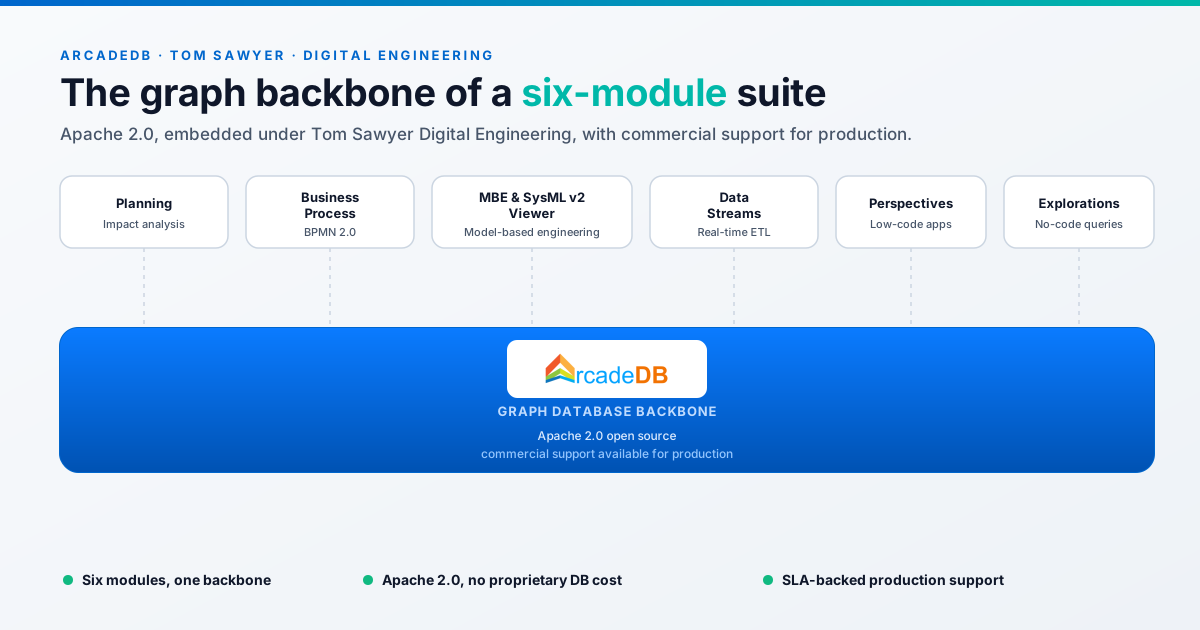
ArcadeDB is now the graph database backbone behind Tom Sawyer Digital Engineering, Tom Sawyer Software’s modular suite for connecting engineering data across the product lifecycle. Every module in the suite, from Planning to Explorations, runs on ArcadeDB underneath. In Tom Sawyer Software’s own words: “ArcadeDB provides the open-source graph database backbone for Tom Sawyer Digital Engineering.”
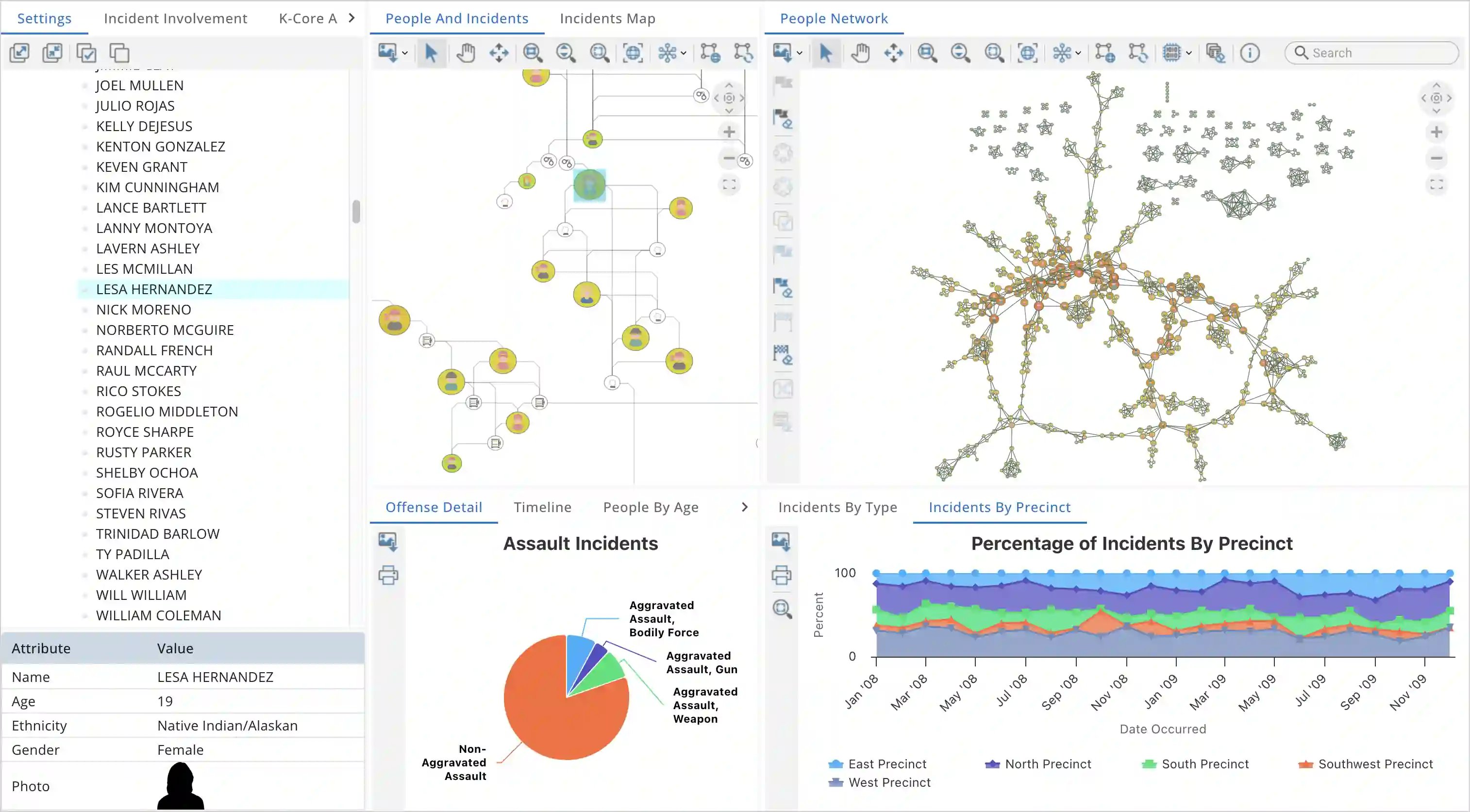 A Tom Sawyer Software graph analytics dashboard built on demo crime-network data: entity relationships, a full network graph, and linked incident charts, all views over the same connected data. Image: tomsawyer.com.
Tom Sawyer Software has built graph analytics and visualization tools for over three decades, and picking a database to sit underneath a commercial engineering product is not a decision made lightly. The Apache 2.0 license is a big part of why: customers get an open-source database with no proprietary licensing cost, and can still add commercial support with SLAs for production environments if they need it.
What Digital Engineering actually does
The suite targets a familiar problem in large engineering organizations: requirements, system models, processes, and change history end up scattered across disconnected tools, and nobody can trace a decision from one end of the product lifecycle to the other. Tom Sawyer Digital Engineering is built to break down those silos with six modules:
- Planning, for visual dependency and change-impact analysis.
- Business Process, a BPMN 2.0-compliant workflow designer and execution engine.
- Model-Based Engineering & SysML v2 Viewer, which generates diagrams automatically from system models.
- Data Streams, real-time ETL for normalizing data coming from disparate sources.
- Perspectives, a low-code platform for building custom knowledge graph applications on top of the same data.
- Explorations, a no-code interface for querying the graph database directly, aimed at business stakeholders rather than engineers.
Every one of those modules is a different way of looking at the same underlying graph: a requirement connects to the system model element that implements it, which connects to the process step that changes it, which connects to the person who approved the change. That is exactly the kind of interconnected, schema-flexible data a graph database is built to hold, and it is why a suite spanning six different front ends can share one backbone instead of six separate stores.
Why this fits ArcadeDB’s model
Tom Sawyer Software’s page frames ArcadeDB specifically as a graph database, but ArcadeDB is multi-model underneath: the same engine that stores the graph also handles document, key-value, search, vector, and time-series data without a separate database to run or a separate query language to learn for each. For a suite where traceability, search, and analytics all touch the same records, that means Digital Engineering does not need to bolt on a second system when a module needs something other than graph traversal, whether that is full-text search over requirements or vector similarity for finding related model elements.
Digital Engineering is a web-based suite, which means it talks to its data store the way most web applications do: as a client-server deployment rather than an embedded library. That is the deployment mode ArcadeDB was built to run in, alongside the embedded mode used when a database needs to live inside another application’s process.
An open-source backbone, with a commercial path
The detail worth underlining is the licensing structure Tom Sawyer Software chose to build on. ArcadeDB’s Apache 2.0 license means Digital Engineering customers are not paying a database vendor on top of paying Tom Sawyer Software, and are not locked into a proprietary format if they ever want to inspect or migrate their own data. For teams that need guarantees beyond what a community can offer, commercial ArcadeDB support with service-level agreements is available as a separate, optional layer, so the choice of open source under the hood does not mean going without a support contract for production.
If you are evaluating a graph database for graph analytics of your own, rather than through Tom Sawyer Software’s suite, the same traversal, pattern-matching, and multi-model engine described above is available directly: SQL, Cypher, and Gremlin against the same records, embedded or client-server, under the same Apache 2.0 license.